

The Dollar And The TSP Funds
The price of the U.S. Dollar Index, ticker symbol DXY, has been a big part of the financial news narrative in 2025. Since peaking in January, the dollar has lost over 10% of its value against a basket of international currencies including the Euro, Yen, Pound, Canadian Dollar, Swedish Krona, and the Swiss Franc.
While only one component contributing to the performance of stock prices, the direction of the dollar index can be very important under certain geopolitical and macro-economic conditions.
How does the price of the U.S. dollar affect the TSP funds, and is the decline in the dollar likely to continue?
The Dollar
The U.S. Dollar is a currency. It's value exists relative to other country's currencies. As TSP investors, we care about the dollar index (DXY) as opposed to the dollar relative to any specific country. Why do we care about the dollar index and how does it relate to the TSP funds?
Understanding the direction of the dollar index can help us form a bias as to which of the TSP funds may provide the best rate of return in the future.
The C fund tracks the S&P500 which is made up of the largest 500 U.S. companies. While these companies are flagged in the U.S., they are mostly very large, multinational corporations. A strong dollar (when the DXY is moving higher) hurts multinational corporations, as the value of foreign earnings decrease as the value of the dollar increases. On the other hand, a weak dollar is a tailwind for U.S. multinational corporations.
The S fund tracks the Total Composite Stock Market Index. It is comprised of small to medium sized U.S. companies that are not included in the S&P500 index. A strong dollar has less of an impact on the S fund than the C fund as its companies are domestically focused. A strong dollar means cheaper import costs which can actually help the S fund companies. Equally, a weak dollar has little impact on the S fund other than the impact from the overall economy.
The direction of the dollar index has the most impact on the I fund. A strong dollar is a major headwind for international companies. Even if foreign companies perform well, their returns shrink when converted back to a rising U.S. dollar. In a rising dollar environment, the I fund tends to underperform the C and S funds.
The F fund tracks the U.S. Aggregate Bond Index. It has little direct exposure to currency fluctuations but is heavily impacted by changes in interest rates. Interest rates tend to move in the same direction as the dollar index.
The G fund invests in short-term U.S. Treasury securities issued specifically to TSP. Because it’s backed by the U.S. government and not exposed to currency risk, the dollar’s value has almost no direct impact. The main driver of G fund returns is interest rates, which tend to move alongside the dollar.
Now that we understand how the dollar impacts each of the TSP funds, let's examine the dollar index to determine its likely direction going forward.
All things being equal, when the dollar index goes up, the TSP stock funds are under pressure. When the index is falling, the TSP stock funds tend to rally.
The Dollar Index
The DXY peaked in 1985 and bottomed in 2008. A long-term perspective of the dollar index is extremely valuable in helping us anticipate important potential turning points. The last major peak was July 2001 at $120, and we are quickly approaching that level in 2025.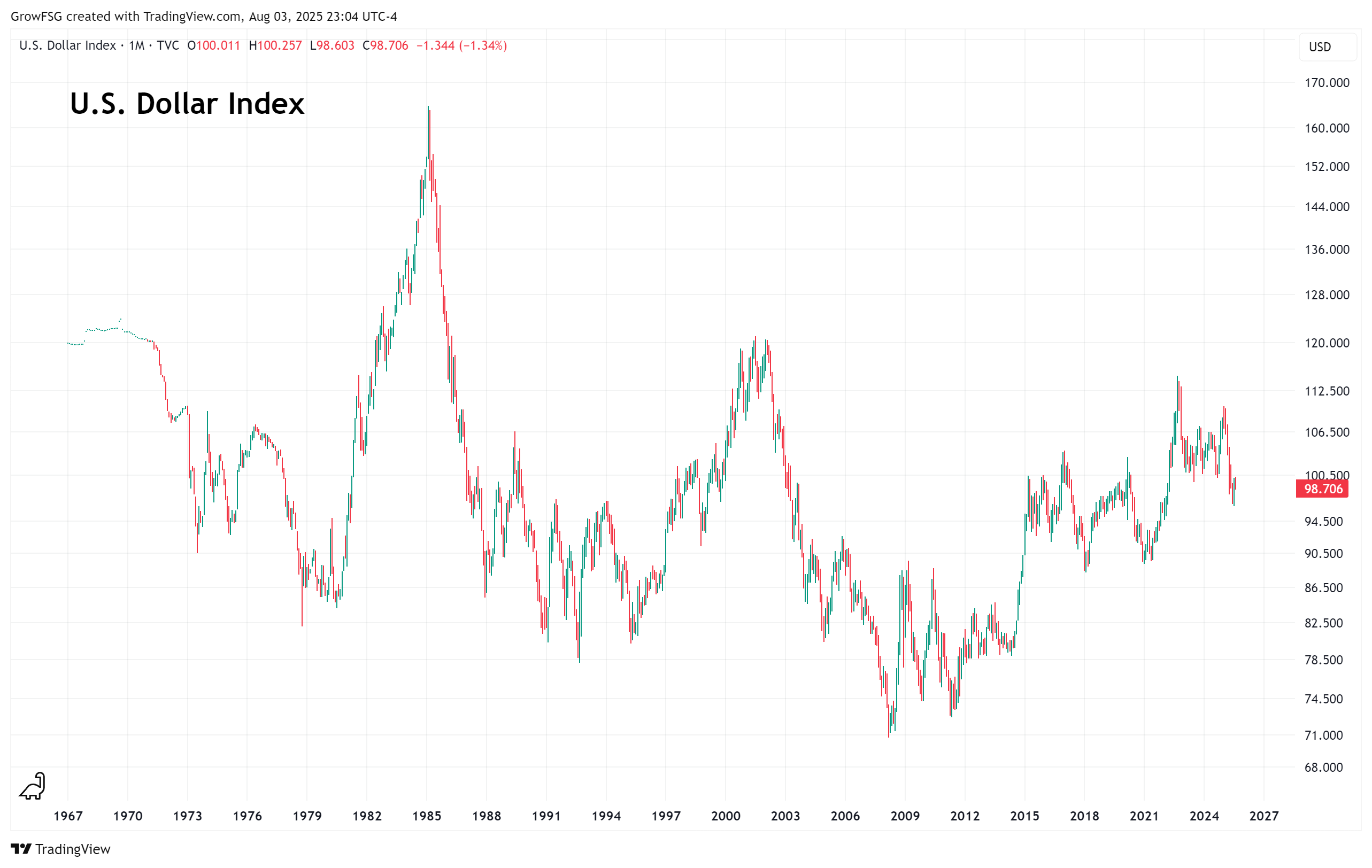
Since its historic bottom in 2008, the dollar has been in a clear uptrend. Though punctuated by numerous sharp declines, each major high is higher than the previous high and each major low is higher than the previous low.
With a new U.S. administration in 2025, a high tariff regime, and the threat of the BRICS alliance, many in the financial media are predicting an end to U.S. dollar dominance. As the dollar has declined sharply in the first half of 2025, the drum beat of the demise of the dollar is getting stronger. While this is certainly a possibility, what does the history of the index suggest?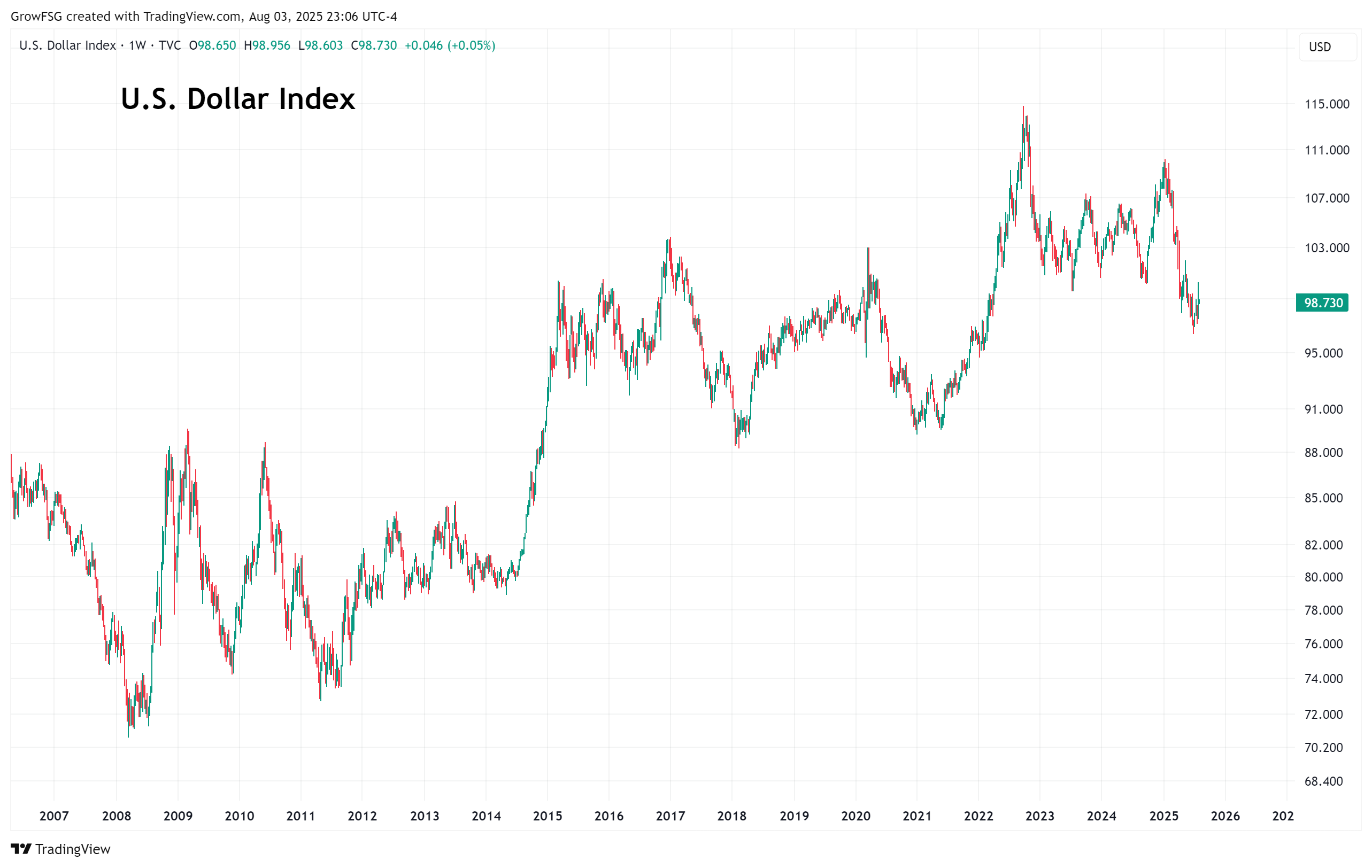
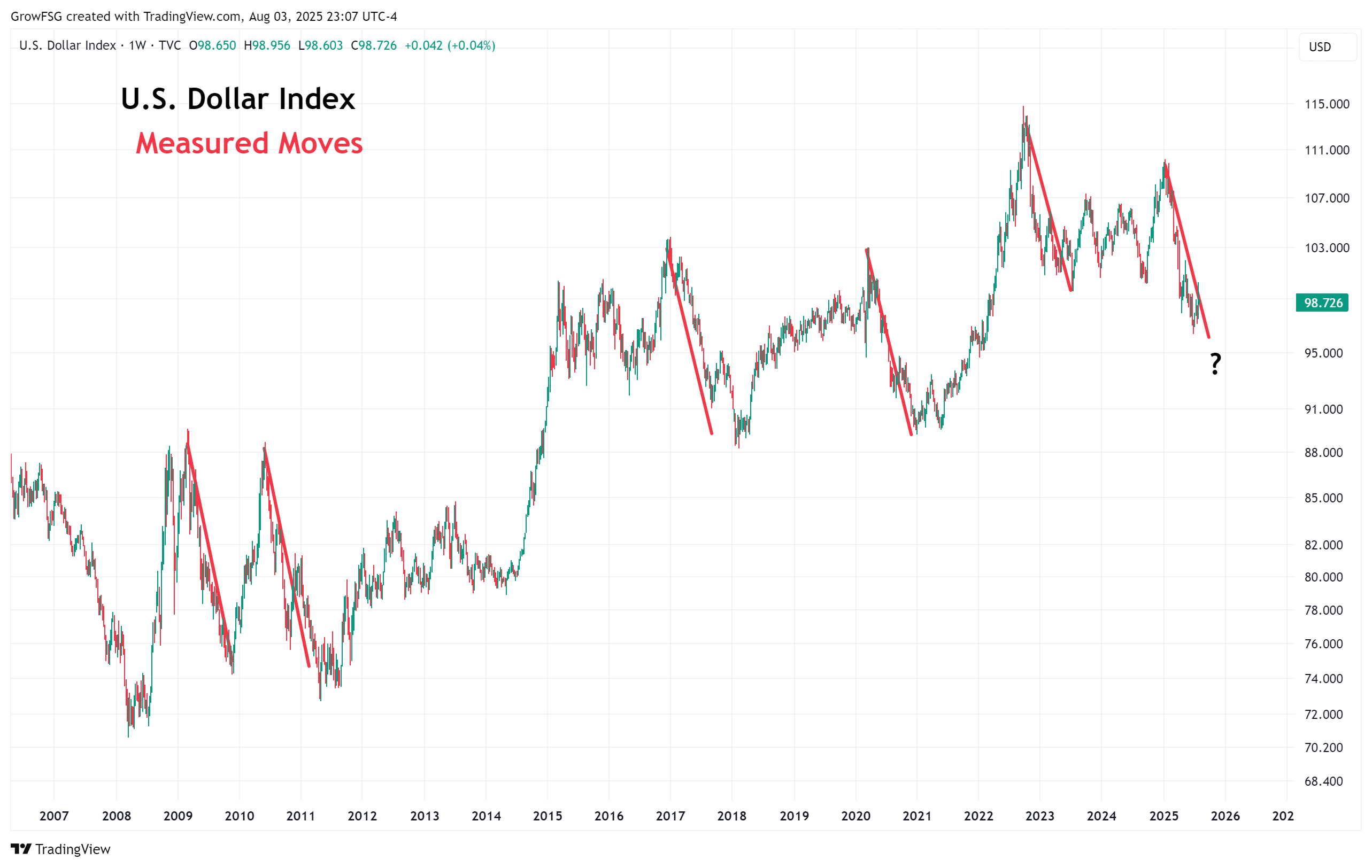
The chart below shows the measured moves of each major decline in the dollar index since its 2008 bottom. This is a logarithmic chart where each red line represents the same percentage decline. While not exact to the penny, each measured move represents approximately a 14% decline from its previous high.
We have seen this measured move repeat over and over since the bottom in 2008. IF the pattern continues, the dollar index should bottom at approximately 96. It hit a low of 96.38 on 01 July 2025.
Whether or not the dollar index continues a bit lower, the majority of the downside for this cycle is likely over. Based on the history of this chart, the dollar should begin a new rally to the upside.
The chart below shows the long-term trendline of the dollar index going back to 2008. Price pierced the trendline slightly in early July 2025, but by the end of the month, exploded to the upside. Is this the beginning of a new multi-year rally for the dollar index? That is what this trendline analysis suggests.
What If This Time Is Different?
What if the dollar continues to collapse through the 95 level or lower?
A collapse down through the trendline will be the first indication that the multi-decade uptrend of the dollar index has likely ended. While that is a possibility, it is not reflected in the chart as of early August 2025. This chart shows strong support at the trendline and an explosive move to the upside.
Could the index roll over and end the long-term trend of dollar dominance? Yes, and someday it will happen. Until then, the trend is your friend...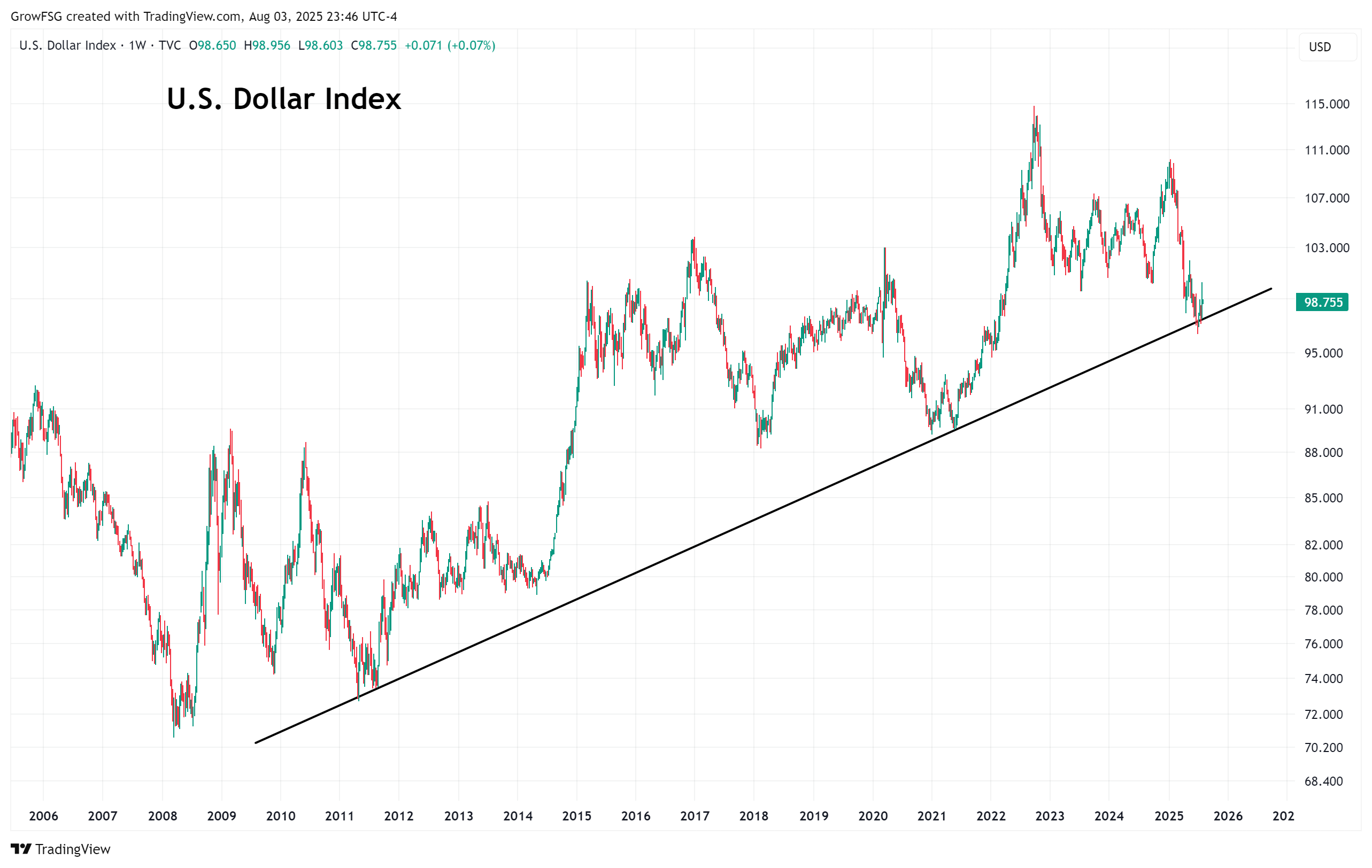
Bottom Line
The direction of the dollar index is just one of many components that drives the price of the TSP funds.
We saw the significance of the dollar in the first half of 2025. As the dollar collapsed, the price of the I fund exploded to the upside. If we have just seen a long-term bottom in the dollar, then the I fund will be under pressure going forward.
A rising dollar environment is a headwind for stocks; particularly the I fund. This is just one of many factors we must consider when making reallocation decisions in TSP.
If this type of analysis speaks to you, check out our Newsletter, Educational Courses, Podcast, and more at GrowMyTSP.com!
-----------------------------------------
GrowMyTSP.com does not provide personal investment advice. We are an education and analysis service, helping TSP investors grow their accounts using strategies and models that best fit their personal circumstances and risk tolerance. Get started at GrowMyTSP.com.
